



Creating Career Path...

Finding Further Careers...

Electronics Engineer

View this career for different education levels:

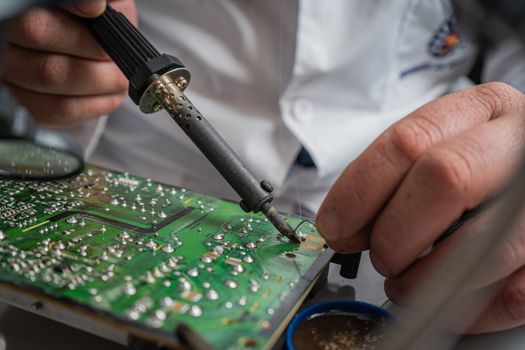
An Electronics Engineer in the UK is at the forefront of designing, developing, and testing electronic components, systems, and equipment. This diverse role involves working with everything from microchips and circuit boards to communication systems and consumer electronics. Your daily tasks might include researching new technologies, creating prototypes, running simulations, and ensuring that designs meet safety regulations and performance standards. You could find yourself working in a wide range of industries, including telecommunications, automotive, aerospace, healthcare (medical devices), defence, and consumer electronics. It often requires strong problem-solving skills, attention to detail, and a deep understanding of electrical principles, digital and analogue circuits, and software. Collaboration with other engineers, designers, and project managers is a common part of the job, as is continuous learning to keep up with rapidly evolving technology.

Electronics Engineer

Flag Media

Please select a reason for flagging this content.

📊 Statistics

Average Starting Salary

For an entry-level Electronics Engineer in the UK, typical starting salaries range from 25,000 to 30,000 per annum, though this can vary based on location, company size, and specific industry sector.

Experienced Professional Salary

Experienced Electronics Engineers in the UK can expect to earn between 35,000 and 60,000 per annum. Highly specialised or senior roles, particularly in areas like aerospace or defence, can command salaries exceeding 70,000.

Job Outlook

The engineering sector in the UK generally shows consistent demand. While specific figures for 'Electronics Engineer' are often grouped within 'Electrical Engineers', the overall engineering profession is projected to grow, with a steady need for skilled professionals in areas like automation, renewable energy, and telecommunications.

🚀 Careers in this path

Flag Media

Please select a reason for flagging this content.

Embedded Systems Engineer

Designs and develops the software and hardware for specialised computer systems often found within larger devices, like smart home tech or automotive systems. Focuses on low-level programming and hardware interaction.

Flag Media

Please select a reason for flagging this content.

RF Engineer

Specialises in the design, development, and testing of devices and systems that operate using radio frequencies, essential for mobile phones, Wi-Fi, and broadcast communications. Involves antenna design and signal processing.

Flag Media

Please select a reason for flagging this content.

Power Electronics Engineer

Works on systems that control and convert electrical power, crucial for renewable energy, electric vehicles, and efficient power supplies. Focuses on high-power circuits, motor drives, and energy management.

Foundation and Education

Achieve Strong A-Levels or Equivalent

Gain excellent grades in relevant subjects to secure a university place for an engineering degree.

Focus on subjects like Maths (essential), Physics (highly recommended), and potentially further Maths or Computer Science. These subjects provide the foundational knowledge in problem-solving, mechanics, and computational thinking crucial for any engineering discipline, especially electronics. Good grades in these subjects will be critical for admission to competitive engineering programmes at UK universities.

Pursue a Relevant University Degree

Enrol in an accredited Bachelor's degree in Electronic Engineering, Electrical and Electronic Engineering, or a closely related field.

Most aspiring Electronics Engineers in the UK pursue either a BEng (Bachelor of Engineering) or MEng (Master of Engineering) degree. An MEng is a four-year integrated Master's degree often preferred by employers and can lead directly to Chartered Engineer (CEng) status after further experience. Look for degrees accredited by the Institution of Engineering and Technology (IET), as this is vital for professional registration. Key modules will include circuit theory, digital electronics, analogue electronics, embedded systems, signal processing, and electromagnetism.

Engage in Personal Projects and Societies

Actively participate in university engineering societies and undertake personal electronics projects to build practical skills.

Joining societies like Robotics, Formula Student, or Electronics Club provides invaluable hands-on experience, teamwork opportunities, and networking with peers and academics. Additionally, starting your own projects using microcontrollers (e.g., Arduino, Raspberry Pi), soldering, and circuit design software (e.g., Eagle, KiCad) demonstrates initiative and practical application of theoretical knowledge, making you stand out to potential employers. Document these projects to showcase in your portfolio.

Gaining Experience and Specialisation

Undertake Internships or Placements

Secure industrial placements or summer internships during your degree to gain real-world engineering experience.

Many universities offer placement year programmes (sandwich courses) which are highly beneficial. These provide practical experience within a professional engineering environment, allowing you to apply your academic knowledge, learn industry standards, and develop professional soft skills. It's an excellent way to network and can often lead to a graduate job offer. Start applying early, typically in your second year for a third-year placement or in your penultimate year for summer internships.

Develop Specialised Skills

Identify areas of interest within electronics and acquire specialist skills through coursework, projects, and certifications.

Electronics engineering is vast. Consider specialising in areas like embedded systems, RF design, power electronics, analogue circuit design, digital signal processing, or FPGA development. Take elective modules in these areas, work on relevant final-year projects, and consider online courses or certifications in specific software tools (e.g., SPICE, Altium Designer, Verilog/VHDL) or hardware platforms. This specialisation makes you a more attractive candidate for specific roles.

Build a Professional Network

Connect with industry professionals, attend career fairs, and join professional engineering bodies.

Networking is crucial for career progression. Attend university career fairs, industry events, and webinars. Connect with engineers on platforms like LinkedIn. Consider becoming a student member of the Institution of Engineering and Technology (IET) or the Institution of Mechanical Engineers (IMechE) if your specialisation bridges. These bodies offer access to resources, events, and a network of professionals, providing mentorship opportunities and insights into the industry.

Career Advancement and Professional Recognition

Secure a Graduate Role

Apply for graduate Electronics Engineer positions, often part of structured graduate schemes.

Many larger companies offer structured graduate schemes designed to rotate you through different departments or projects, providing broad experience. Smaller companies might offer direct entry roles. Tailor your CV and cover letter to each application, highlighting relevant projects, internships, and skills. Be prepared for technical interviews and problem-solving assessments. This first role is key for consolidating your learning and starting your journey towards professional registration.

Pursue Professional Registration (CEng)

Work towards achieving Chartered Engineer (CEng) status through a professional engineering institution.

Chartered Engineer (CEng) status is a globally recognised benchmark of engineering competence and commitment. It demonstrates high levels of knowledge, experience, and professional conduct. You typically need an accredited MEng degree (or equivalent BEng plus further learning) and several years of supervised professional experience. You'll need to demonstrate competence across various areas, often through a Professional Review Interview. CEng status enhances your credibility, career prospects, and earning potential.

Continuous Professional Development (CPD)

Regularly update your skills and knowledge through training, courses, and staying abreast of industry trends.

The field of electronics engineering evolves rapidly. To remain competitive and effective, continuous professional development (CPD) is essential. This could involve attending workshops, pursuing further qualifications, reading technical journals, participating in industry conferences, or learning new software tools and technologies. Many professional institutions, like the IET, require members to maintain a record of their CPD. This ongoing learning ensures your skills remain relevant and opens doors to leadership or specialist roles.

🎬 Useful Videos

🎯 View Apprenticeships

Explore relevant apprenticeships that can help you kickstart your career in Electronics Engineer. Apprenticeships offer hands-on experience and training while earning a wage.

Career Progressions

This page showcases various career options and the pathways to reach them. Each career listed here shares transferable skills and knowledge, making it easier for individuals to transition between them.

Your current career is highlighted to help you see how it fits into the broader landscape of potential career choices. By clicking on any career, you can learn more about it, including the training and education required to pursue it.

Remember, progressing in your career often involves further learning and training. This page provides insights into future career options as well as those that can lead up to your current one.

These career progression decisions are informed by comparing the skills and knowledge needed for different occupations, along with data on how people move between them. Explore the possibilities and discover the exciting journey ahead in your career!

Sample Qualifications

The input career 'Electronics Engineer' is an exact match for the official job title 'Electronics engineer' on the provided list, indicating a direct correspondence in qualifications and job duties.

How to become

You can get into this job through:

  • a university course
  • a college course
  • an apprenticeship
  • working towards this role

University

You could do a foundation degree, higher national diploma or degree in electronic engineering.

Employers may also accept related subjects combined with electronics, for example:

  • electronic and electrical engineering
  • aerospace engineering
  • physics and applied physics
  • computer science
  • nanotechnology
  • maths

Entry requirements

You'll usually need:

  • 1 or 2 A levels, or equivalent, for a foundation degree or higher national diploma
  • 2 to 3 A levels, or equivalent, for a degree

More Information

College

You could do electronic engineering or electronic systems engineering at college before applying for a trainee job.

Entry requirements

Entry requirements for these courses vary.

More Information

Apprenticeship

You can apply to do a Level 6 Degree Apprenticeship in electronic engineering, such as:

  • Electrical or Electronic Technical Support Engineer
  • Embedded Electronic Systems Design and Development Engineer

These take between 3 and 5 years to complete. You'll do on-the-job training and spend time with a college or training provider.

Entry requirements

You'll usually need:

  • 4 or 5 GCSEs at grades 9 to 4 (A* to C) and A levels, or equivalent, for a degree apprenticeship

More Information

Work

You could start as an electronics engineering technician and do further training on the job to qualify as an engineer.

More Information

Career tips

Electronics are a fundamental part of everyday day life and there are opportunities to work in many different areas. Examples include:

  • audio equipment
  • telecommunications
  • aerospace
  • vehicle manufacturing
  • medical equipment and assistive technology
  • robotics

Further information

You can find more details about careers and training from The Institution of Engineering and Technology and Electrical Careers.

Interested in More Career Paths?

Explore other careers or use our AI to discover personalised paths based on your interests.

Stay connected

Join our newsletter to stay up to date on features and releases

Address
Developing Experts Limited
Exchange Street Buildings
35-37 Exchange Street
Norwich
NR2 1DP
UK

Phone
01603 273515

Email
[email protected]

Copyright 2026 Developing Experts, All rights reserved.