




Creating Career Path...

Finding Further Careers...

Electronics Engineer

View this career for different education levels:

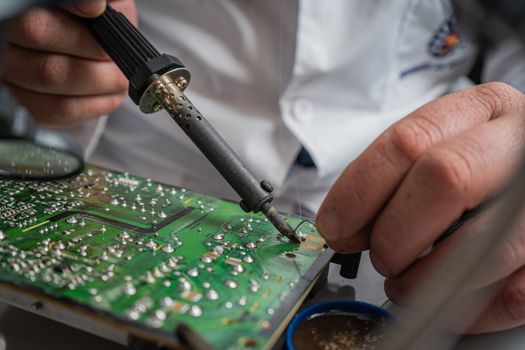
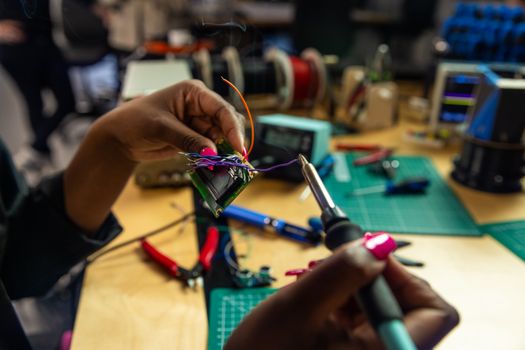
Imagine all the amazing gadgets around you - your phone, the TV, even the lights in your house! An Electronics Engineer is like a super smart detective who figures out how all the electronic parts inside these things work together. They design and build circuits, which are like tiny roads for electricity, to make everything switch on, light up, and do cool stuff. They might be making sure a new robot can move properly, or helping to design the tiny parts that go inside a computer. It is a job where you get to be creative and solve puzzles every day, using science and maths to invent new things or make existing ones better and safer. Electronics Engineers work on all sorts of exciting projects. One day they might be designing a new piece of medical equipment to help doctors, and the next they could be making sure a spaceship communication system works perfectly. They spend a lot of time thinking about how electricity behaves and how to use it safely to power different devices. They often use computers to help them draw their designs and test their ideas before building them for real. It is a very important job because almost everything we use in our modern world relies on electronics!

Electronics Engineer

Flag Media

Please select a reason for flagging this content.

📊 Statistics

Average Starting Salary

For someone just starting out as an Electronics Engineer in the UK, they might earn between 25,000 to 30,000 pounds a year.

Experienced Salary

Engineers with more experience, perhaps after working for a few years, can earn much more, sometimes between 40,000 to 65,000 pounds a year or even higher for very senior roles.

Number of Jobs

There are many jobs for Electronics Engineers across the UK. Thousands of people work in this field, with new jobs appearing regularly in different industries like technology, manufacturing, and even healthcare.

🚀 Careers in this path

Flag Media

Please select a reason for flagging this content.

Robotics Engineer

Imagine building and teaching robots to do cool things, like helping people or exploring new places. You'd design their electronic brains and make them move!

Flag Media

Please select a reason for flagging this content.

Video Game Designer

You could design how video games work, what the characters do, and how players interact with them. You'd use electronics knowledge to understand how consoles and computers bring games to life.

Flag Media

Please select a reason for flagging this content.

Gadget Inventor

Think of new ideas for amazing electronic gadgets, like smart toys, helpful home devices, or futuristic tools. You'd figure out how to put all the little electronic bits together to make them work.

Sparking Your Interest

Play with Electronics Kits

Start by exploring simple electronics kits! These kits are safe and fun ways to learn about how circuits work and how electricity makes things light up or buzz.

Look for beginner-friendly electronics kits online or at toy shops. Kits like Snap Circuits or Makey Makey are great for kids your age. They let you connect different parts like batteries, wires, and light bulbs to build simple machines. You can make a fan spin, a light flash, or even create your own game controller! This helps you understand how electricity flows and makes things happen.

Ask How Things Work

Be curious! Whenever you see an electronic gadget, ask an adult, 'How does this work?' Try to understand the basics of what's inside and what it does.

When you see a remote control, a tablet, or even a toaster, wonder aloud, 'What makes it go?' Your parents, teachers, or even online videos can help explain simple concepts like buttons sending signals, batteries providing power, or screens showing pictures. Learning to ask 'how' is the first step to becoming an engineer who invents new 'hows'!

Visit a Science Museum

Explore a science museum! They often have exciting exhibits where you can touch, play with, and learn about electricity and technology in a super fun way.

Science museums, like the Science Museum in London or local discovery centres, have special areas dedicated to technology, physics, and engineering. You might see giant magnets, learn about static electricity, or even control a robot! These visits can show you the amazing possibilities of electronics and inspire you to learn more about how they are built.

Building Your Knowledge

Enjoy Science and Maths at School

Pay attention in your science and maths lessons at school. These subjects are like the secret code for understanding how electronics work!

Maths helps you understand measurements and calculations, which are super important for designing electronic parts. Science, especially physics, teaches you about electricity, forces, and energy. The more you learn now, the easier it will be to understand complex electronic ideas later on. Ask your teachers questions and try your best!

Join a Robotics Club

If your school has one, join a robotics club! You'll get to build and program robots, which uses lots of electronic skills and is incredibly fun.

Robotics clubs are brilliant because you get hands-on experience putting electronic components together, connecting wires, and even writing simple code to make your robot move or do tasks. It's a fantastic way to learn about sensors, motors, and circuits while working in a team and solving challenges. You might even enter competitions!

Read Books About Inventors

Read books about famous inventors and how they created amazing things. Learning their stories can inspire you to become an inventor too!

There are lots of exciting books about people like Thomas Edison, Marie Curie, or even modern-day tech wizards. You'll discover how they had brilliant ideas, faced challenges, and worked hard to make their inventions a reality. This shows you that being an engineer is about creativity and problem-solving, not just knowing lots of facts.

Becoming an Engineer

Study Engineering at University

After school, you'll go to university to study Electronics Engineering. This is where you'll learn all the super clever stuff about designing circuits and electronic systems.

To become a professional Electronics Engineer in the UK, you typically need to complete a university degree in Electrical and Electronic Engineering or a similar field. This usually takes three or four years and covers topics like circuit design, digital electronics, microprocessors, and signal processing. Universities like Imperial College London, Cambridge, and Manchester are very well known for their engineering courses.

Do Work Experience

Try to get some work experience while you're studying or during your holidays. This means spending time at a company where engineers work to see what they do every day.

Work experience placements, often called internships or industrial placements, are a great way to see what being an Electronics Engineer is really like. You might get to help out on real projects, learn how a company designs products, and meet engineers already working in the field. This experience looks really good on your CV when you're looking for your first job after university.

Start Your First Engineer Job

Once you've finished university, you can apply for a job as a Junior Electronics Engineer! You'll start helping to design and build exciting new electronic gadgets.

As a new Electronics Engineer, you might work in different industries like telecoms, aerospace, consumer electronics, or even medical technology. Your first job could involve testing circuits, helping to design parts of a new device, or writing code for embedded systems. You'll keep learning and growing your skills as you work on more and more interesting projects, helping to create the technology of the future!

🎬 Useful Videos

🎯 View Apprenticeships

Explore relevant apprenticeships that can help you kickstart your career in Electronics Engineer. Apprenticeships offer hands-on experience and training while earning a wage.

Career Progressions

This page showcases various career options and the pathways to reach them. Each career listed here shares transferable skills and knowledge, making it easier for individuals to transition between them.

Your current career is highlighted to help you see how it fits into the broader landscape of potential career choices. By clicking on any career, you can learn more about it, including the training and education required to pursue it.

Remember, progressing in your career often involves further learning and training. This page provides insights into future career options as well as those that can lead up to your current one.

These career progression decisions are informed by comparing the skills and knowledge needed for different occupations, along with data on how people move between them. Explore the possibilities and discover the exciting journey ahead in your career!

Sample Qualifications

The user's input career 'Electronics Engineer' is an exact match for the official job title 'Electronics engineer' provided in the list. Both titles refer to professionals who design, develop, test, and supervise the manufacture and installation of electronic equipment.

How to become

You can get into this job through:

  • a university course
  • a college course
  • an apprenticeship
  • working towards this role

University

You could do a foundation degree, higher national diploma or degree in electronic engineering.

Employers may also accept related subjects combined with electronics, for example:

  • electronic and electrical engineering
  • aerospace engineering
  • physics and applied physics
  • computer science
  • nanotechnology
  • maths

Entry requirements

You'll usually need:

  • 1 or 2 A levels, or equivalent, for a foundation degree or higher national diploma
  • 2 to 3 A levels, or equivalent, for a degree

More Information

College

You could do electronic engineering or electronic systems engineering at college before applying for a trainee job.

Entry requirements

Entry requirements for these courses vary.

More Information

Apprenticeship

You can apply to do a Level 6 Degree Apprenticeship in electronic engineering, such as:

  • Electrical or Electronic Technical Support Engineer
  • Embedded Electronic Systems Design and Development Engineer

These take between 3 and 5 years to complete. You'll do on-the-job training and spend time with a college or training provider.

Entry requirements

You'll usually need:

  • 4 or 5 GCSEs at grades 9 to 4 (A* to C) and A levels, or equivalent, for a degree apprenticeship

More Information

Work

You could start as an electronics engineering technician and do further training on the job to qualify as an engineer.

More Information

Career tips

Electronics are a fundamental part of everyday day life and there are opportunities to work in many different areas. Examples include:

  • audio equipment
  • telecommunications
  • aerospace
  • vehicle manufacturing
  • medical equipment and assistive technology
  • robotics

Further information

You can find more details about careers and training from The Institution of Engineering and Technology and Electrical Careers.

Interested in More Career Paths?

Explore other careers or use our AI to discover personalised paths based on your interests.

Stay connected

Join our newsletter to stay up to date on features and releases

Address
Developing Experts Limited
Exchange Street Buildings
35-37 Exchange Street
Norwich
NR2 1DP
UK

Phone
01603 273515

Email
[email protected]

Copyright 2026 Developing Experts, All rights reserved.