

Creating Career Path...

Finding Further Careers...

Metalworking Production and Maintenance Fitter

View this career for different education levels:

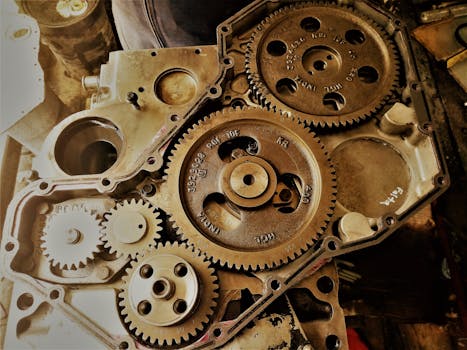
Imagine you have a giant set of building blocks, but instead of plastic, they are made of metal. A Metalworking Production and Maintenance Fitter is like a super builder and fixer for these metal blocks, especially in places that make things. They are really good at putting together big metal machines and making sure all the parts fit perfectly. They might use cool tools like wrenches and grinders to make sure everything is strong and safe. When a machine breaks down or stops working properly, they are the brave heroes who find the problem and fix it, making sure the factory can keep making things without a long stop. They are like doctors for big metal machines, making sure they are always healthy and doing their job. This job is super important because without these fitters, the machines that make our cars, planes, and even parts for our houses would stop working. They read special drawings, like treasure maps, to know exactly how to put machines together or how to fix them. They also check machines regularly to make sure they do not break down in the first place, which is called maintenance. It is a hands-on job where you get to build, fix, and keep big metal things working smoothly.

Metalworking Production and Maintenance Fitter

Flag Media

Please select a reason for flagging this content.

📊 Statistics

Salary Range

A Metalworking Production and Maintenance Fitter in the UK can expect to earn between 25,000 and 38,000 pounds a year, depending on their experience and where they work.

Job Openings

There are usually thousands of job openings for fitters and related roles across the UK each year, showing it is a job that is often needed in factories and workshops.

Working Hours

Most fitters work around 40 hours a week, often during the daytime, but sometimes they might work evenings or weekends if something important needs fixing quickly.

🚀 Careers in this path

Flag Media

Please select a reason for flagging this content.

Train Building Helper

Imagine helping to build big, fast trains! You'd learn how to put the right parts together and check that everything is strong and safe for passengers.

Flag Media

Please select a reason for flagging this content.

Robot Maker Assistant

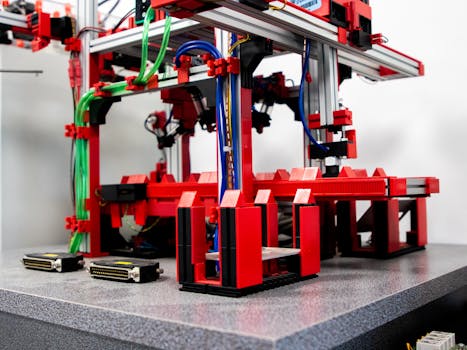
Do you like robots? You could help make and fix amazing robots that do jobs in factories, learning how all their metal parts fit together perfectly.

Flag Media

Please select a reason for flagging this content.

Aircraft Parts Constructor

This job is about helping to build the metal parts for aeroplanes, making sure they are super strong and fit together just right so planes can fly safely.

Learning About Tools and Safety

Explore Tools

Find out about all the different tools that people use to work with metal. You can look at pictures or videos to see what they do.

Start by identifying common hand tools like spanners, screwdrivers, hammers, and measuring tapes. Learn their names and what they are generally used for. You could also explore basic power tools like drills or grinders, focusing on understanding their purpose rather than using them at this age. Understanding these tools is the first step in seeing how things are made and fixed.

Understand Safety First

It's super important to know how to be safe around tools and machines. Learn about wearing special gloves or glasses to protect yourself.

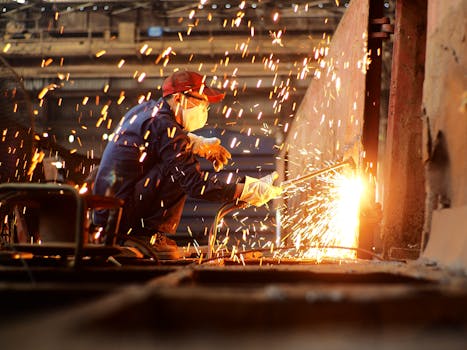
Safety is paramount in any metalworking environment. For an 8-year-old, this means understanding the importance of personal protective equipment (PPE) like safety glasses to protect eyes from sparks or flying debris, gloves to protect hands, and sturdy shoes. It's also about knowing not to touch machines without an adult and to always follow instructions. Simple rules like 'don't run in a workshop' or 'report anything broken' are good starting points.

See How Things Are Made

Watch videos or visit places (if you can!) where people make things with metal. See how big machines help create cool objects.

Look for documentaries or online videos that show factories or workshops where metal items are produced. You might see machines cutting large sheets of metal, bending tubes, or welding pieces together. Observing these processes helps you understand the 'production' part of the job. If possible, a supervised visit to a local workshop or manufacturing facility (even a small one) can be incredibly insightful, but always with strict safety rules in place.

Getting Ready for Bigger Learning

Do Well in Maths and Science

Maths helps you measure things, and science helps you understand how things work. These are important for fixing machines!

Excelling in Maths helps with understanding measurements, angles, and problem-solving, which are all crucial for fitting parts accurately and diagnosing machine issues. Science, particularly physics, helps you grasp concepts like forces, motion, and how different materials behave. Pay attention in these subjects as they build a strong foundation for future technical learning.

Build and Create Things

Play with building blocks, LEGO, or construction kits. This helps you learn how parts fit together and how to make things strong.

Engaging in hands-on activities like building models, using LEGO Technic sets, or even simple construction kits for children helps develop spatial awareness, problem-solving skills, and an understanding of mechanical principles. It teaches you how different components connect, how to follow instructions to build something, and how to troubleshoot when something doesn't fit quite right. These skills are very similar to what a Fitter does when assembling or repairing machines.

Ask Questions About Machines

When you see machines, like washing machines or bikes, ask an adult how they work and what makes them move.

Develop a curious mind! Whenever you encounter a machine, whether it's a household appliance, a car, or even a simple bicycle, ask an adult how it functions. How does the engine make the car move? What makes the washing machine spin? Understanding the basic mechanics of everyday objects can spark a deeper interest in engineering and maintenance, which is exactly what a Metalworking Fitter does with more complex industrial machines.

Future Training and Education

Explore Practical School Subjects

When you're older, choose subjects in school that involve making things or understanding technology, like Design and Technology.

As you get older and move into secondary school, consider taking subjects like Design and Technology (DT), Engineering, or Resistant Materials. These subjects offer practical experience with tools and materials, helping you develop hands-on skills and understand manufacturing processes. They are often the first step towards more vocational training or further education in engineering.

Look into Apprenticeships

After school, you can learn a job by doing an apprenticeship. This means you work and learn at the same time, earning a little money too!

Apprenticeships are a fantastic way to become a Metalworking Production and Maintenance Fitter in the UK. You'll work for a company, learning from experienced professionals while also studying for qualifications like NVQs or BTECs. This 'earn while you learn' approach gives you real-world experience, practical skills, and a qualification, making you job-ready for the industry. Many engineering companies offer apprenticeships specifically for fitters.

Consider College Courses

You could also go to a college to study engineering or manufacturing. They teach you all about how machines work and how to fix them.

Another path is to enrol in a college course focusing on engineering, mechanical engineering, or manufacturing. These courses, such as BTECs or diplomas, provide theoretical knowledge and practical skills in a classroom and workshop setting. They can prepare you for an entry-level Fitter role or lead to higher education if you wish to specialise further. Look for courses that include hands-on machine maintenance, fabrication, and health and safety.

🎬 Useful Videos

🎯 View Apprenticeships

Explore relevant apprenticeships that can help you kickstart your career in Metalworking Production and Maintenance Fitter. Apprenticeships offer hands-on experience and training while earning a wage.

Career Progressions

No career progressions found for Metalworking Production and Maintenance Fitter

Sample Qualifications

The user's career explicitly includes 'Maintenance Fitter' and 'Metalworking Production' implies a skill set that aligns with the broader responsibilities of a general 'Maintenance fitter', which would involve working with machinery and equipment in a production environment.

How to become

You can get into this job through:

  • a college course
  • an apprenticeship
  • working towards this role
  • applying directly

College

You could take a college course to learn some of the skills you'll need in this job. 

Relevant subjects include:

  • engineering
  • mechanical or electrical engineering
  • fabrication and welding
  • T Level in Maintenance, Installation and Repair for Engineering and Manufacturing

Entry requirements

Entry requirements for these courses vary.

  • 4 or 5 GCSEs at grades 9 to 4 (A* to C), or equivalent, including English and maths for a T Level

More Information

Apprenticeship

You could apply to do an apprenticeship, such as:

  • Engineering and Manufacturing Level 2 Foundation Apprenticeship
  • Engineering Fitter Level 2 Intermediate Apprenticeship
  • Engineering Maintenance Technician Level 3 Advanced Apprenticeship
  • Maintenance Operations Engineering Technician Level 3 Advanced Apprenticeship

Foundation apprenticeship

You can apply for a foundation apprenticeship if you're aged 16 to 21.

If you're aged 22 to 24, you can apply if you:

Entry requirements

You'll usually need:

  • no specific qualifications or experience to apply for a foundation apprenticeship
  • some GCSEs, usually including English and maths, or equivalent, for an intermediate apprenticeship
  • 5 GCSEs at grades 9 to 4 (A* to C), or equivalent, including English and maths, for an advanced apprenticeship

More Information

Work

You could start as an engineering operative or trainee craftsperson and do training on the job to become a fitter.

Direct Application

You can apply directly for maintenance fitter jobs if you've got qualifications and experience in maintenance work, like:

  • mechanical engineering
  • pipefitting
  • welding
  • electrical engineering

More Information

Registration

Further information

You can find more about careers in engineering from the ECITB and Tomorrow's Engineers.

Interested in More Career Paths?

Explore other careers or use our AI to discover personalised paths based on your interests.

Stay connected

Join our newsletter to stay up to date on features and releases

Address
Developing Experts Limited
Exchange Street Buildings
35-37 Exchange Street
Norwich
NR2 1DP
UK

Phone
01603 273515

Email
[email protected]

Copyright 2026 Developing Experts, All rights reserved.